

“STL died on the cross this weekend—60 crosses, 1 goal. A martyr to inefficiency.”
“STL hit 60 crosses… and still couldn’t resurrect their attack.”
STL’s weekend: all cross, no salvation.
Think some of those are pretty good.
Hello. If you sensed frustration, congratulations — your tactical sixth sense is working. Today, we’re talking numbers. And what they say about CITY’s tactical identity.
If you haven’t heard, CITY hit 60 crosses on Saturday night against 10-man Dallas (we lost one on a stat correction). They took 42 shots and generated 3.5 xG.
Let’s talk about all three of those numbers.
Crosses: The Obsession
Let’s start with the crosses. Yes, 60 is a lot. But it’s not the number itself that — I was going to say annoys, but it’s more than that — angers me.
It was the insistence. The doubling and tripling down on that crossing was the way to break through Dallas. That it was the only way to create chances against a team down a man. Wallem and Pompeu alone attempted 25 crosses.
Two weeks ago, CITY averaged 16.5 crosses per game under Critch through 12 games. In 15 games under Olof, CITY averaged 16.3 crosses.
In the last two games? CITY hit 100 crosses, skyrocketing the season average from 16.3 to 21.3 per game.
Forgive me if I’m miscounting; I’m reasonably sure CITY scored three goals in those two games — two of them being absolute screamers from distance, Goal of the Week contenders, and neither coming from a cross.
So, another way to phrase it: CITY hit 100 crosses in a week and scored once from one (shoutout Myhki). That’s a 1% conversion rate.
I, along with people much smarter than I, have talked about crosses in depth before. The gist? Crosses are low-probability events. They’re often overhit, underhit, claimed by the keeper, or cleared by a defender. Completion rates vary, but on average, 20–25% of crosses reach a teammate.
But completing a cross doesn’t mean it results in a goal. Most crosses are headed, and heading is hard. Rarely does a player get a clean, uncontested header with perfect timing and power. Usually, they’re jostling with a defender, off-balance, or misjudging the ball’s flight.
Even when it all lines up, the conversion rate of crosses is about 1.6% — 1 in 64.
And I’m a believer in efficiency and optimization.
CITY hit 60 crosses against Dallas. That was supposed to win us the game?
The math says there’s a ~70% chance we don’t score more than one goal from all those crosses. That’s the tactical identity?
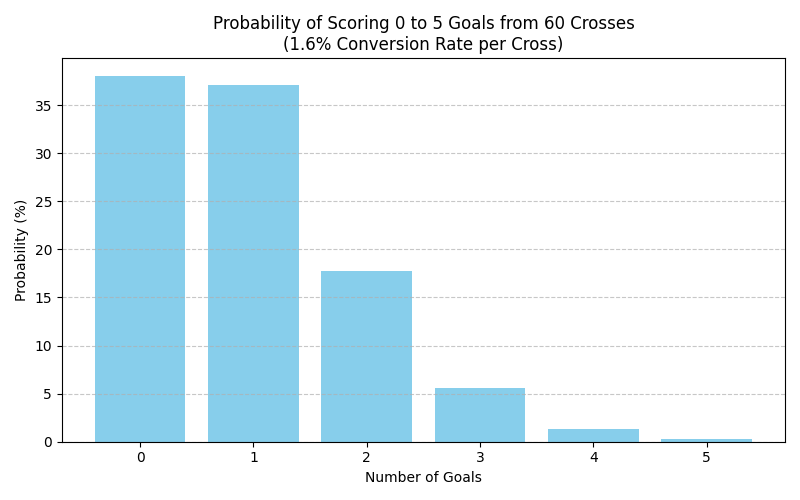
CITY hit 100 crosses this week. CITY scored one goal from those crosses. The math says that’s precisely what we should expect. Again, CITY is choosing to do this?
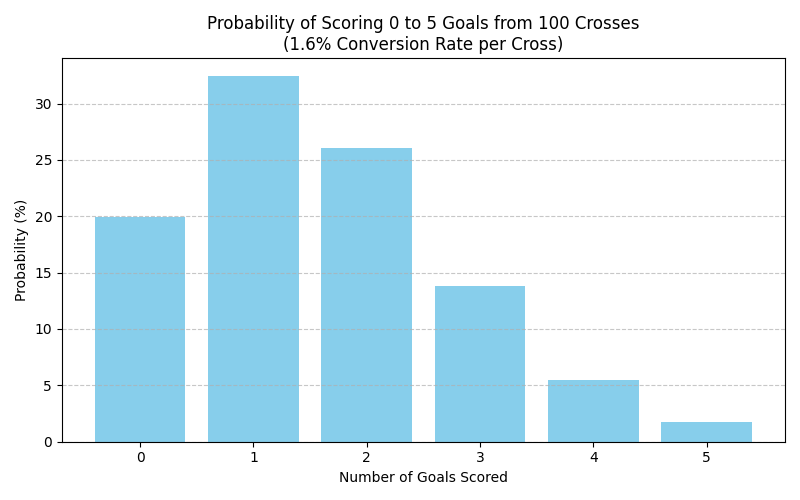
So while it may seem like I’m harping on the number of crosses, my intent is to highlight the number of crosses as a means to, frankly, insinuate that the methodology is broken at St. Louis CITY SC.
Shots: Quantity vs. Quality and xG Accumulation
A reminder: xG is the best metric we have for predicting soccer results, but it’s not perfect. It wasn’t designed to explain a single game — especially not one as chaotic and low-scoring as soccer often is. But over time, xG correlates strongly with goals scored. Teams that consistently generate high xG tend to win more.
CITY took 42 shots against a 10-man Dallas side — a number that suggests dominance. But when you break those shots down by quality, the story shifts from control to inefficiency.
Here’s how CITY’s 42 shots stack up:
Poor: 17 shots
Average: 21 shots
Good: 3 shots
Great: 1 shot — and it was blocked
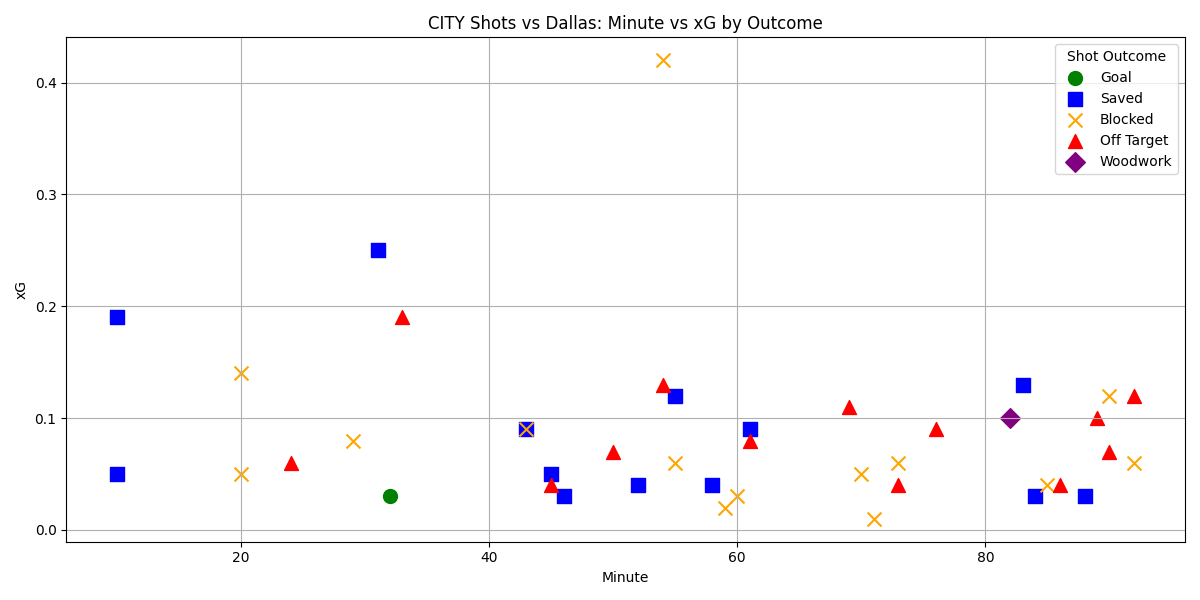
That’s right — CITY created just one “Great” chance all night, and it didn’t even result in a shot on target.
The lone goal? A deflected long-range effort from Célio Pompeu with an xG of 0.03 — firmly in the “Poor” category.
So while CITY generated 3.64 xG, the conversion rate was just 2.38%. The volume was there, but the quality was not. Most shots were speculative, hopeful, or heavily contested. And against a team down a man, that’s not just inefficient — it’s tactically negligent.
We know crossing is difficult and inefficient, so let’s just overwhelm that with sheer volume. The crossing isn’t working, and when it does work, we’ve already discussed the conversion rate of crosses. So let’s just shoot everything?
Against a compact, undermanned side, CITY could’ve exploited central overloads, quick one-twos, or vertical passing lanes — instead, they chose the least efficient path.
xG accumulation can be misleading. A team can rack up xG through sheer shot quantity, even if most attempts are low-quality. CITY generated 3.64 xG, but only one shot was in the “Great” category — and it was blocked. Game state, momentum, and psychological pressure aren’t captured. A 0.20 xG chance in the 5th minute isn’t the same as one in the 90th. Build-up play and tactical intent aren’t rewarded. A beautiful sequence that ends in a blocked shot gets the same xG as a hopeful long ball.
Still, xG remains the most reliable tool we have. It separates volume from value and allows for objective comparisons across games, teams, and leagues.
If CITY wants to improve, they need to shift from volume-based attacking to value-based chance creation. They took 42 shots, but only four were in the “Good” or “Great” category. That’s not a finishing problem — it’s a chance creation problem, and it’s something myself and others have been talking about ad nauseam for months, years even.
This will be hard to hear for the “SHOOOOOOT” crowd, but CITY needs to stop settling for low-probability efforts and start prioritizing central areas and high-percentage zones inside the box. It’s a fine line, certainly. CITY should be aggressive — take shots when the opportunity is there — but also know when to pass up an average shot in the hopes of creating a better one.
Turnovers in promising areas will happen, and that’s actually okay. Not enough turnovers means you’re not trying. Too many means you’re reckless. Good teams find that thin threshold — the balance between bravery and opportunity — and CITY needs to start walking that line.
Too often, CITY forces crosses or long shots when a cutback or through ball could create a better look. Positional rotations, third-man runs, and quick combinations can open up space in dangerous areas — especially against a compact or undermanned defense.
Against a 10-man Dallas, CITY should have overloaded central zones, drawn defenders out, and created mismatches. Instead, they chose the least efficient path — flooding the box with crosses into a crowd.
Final Thoughts
So what are we left with?
A team that hit 60 crosses, took 42 shots, generated 3.64 xG, and scored once, from a deflected long-range effort with a 0.03 xG value. That’s not dominance. That’s noise.
CITY didn’t lose because of bad luck. They didn’t draw because of poor finishing. They failed to win because the tactical approach was flawed from the start — a stubborn commitment to low-efficiency methods, executed with volume instead of precision.
And this brings me back to a point I’ve been making subtly for weeks: the right back situation. Totland is a fine RB. Wallem is also a fine RB. Playing Wallem over Totland is fine — if the tactics and the results are working. But they’re not. Totland hasn’t started the last six games, and only featured in the latest one out of desperation. CITY has 4/18 points in that stretch. That’s not the sign of tactical nuance working. That’s the sign of tactical stubbornness failing.
The short-term manager is playing the short-term player and not achieving any short-term results. The long-term people — Totland, the club, the fans — are going to be the ones left holding the bag when the short-termers are gone. And that’s unacceptable.
And I’ll say one last thing on this point. Olof had 15 games in charge before he was run out of town with 11 points and 0.73 PPG. David Critchley has 14 games in charge, also with 11 points, sitting at 0.79 PPG. If CITY loses this weekend, it’s identical. The difference? Not much. I’m not Pro-Olof or rethinking the firing, but let’s call a spade a spade. This entertaining, field tilt, blah blah blah brand of soccer that Critchley promised to bring back? It’s shit. It’s as shit as Olof’s. And both are slightly better shits than Hackworth’s, who was really shit — and got absolutely walloped in his 14 games with a -8.3 xGD.
The sporting side of the club needs a reset. And that doesn’t even touch on the fact that the business side of the club is too cowardly to allow promotion of a cause against childhood cancer.
Losing on the pitch. Losing off the pitch. Be better, St. Louis CITY SC.
I am #AllForCITY, forever and always, but make it easier, please.
Your analysis and commiseration are spots of light in a dark time for CITY fans. Thank you for writing, researching and sharing.
With Dallas at 10 and backing all the way up to the penalty spot, I couldn’t understand why blasting on net and hoping for a pinball wouldn’t be better than what we did? That was the worst game I’ve watched or attended and I’ve seen us lose plenty. This was the worst because we weren’t beaten. We beat ourselves.