

First off, thank you for the incredible response to Part 1 of the WWMD offseason series on CITY’s Expiring Contracts. In that piece—and in the days leading up to it—CITY made nearly every contract option decision I would’ve made.
Since then, I’ve been vocal about the process and those leading it. And now, with Corey Wray officially appointed as CITY’s second Sporting Director and his comments on the state of the roster, it’s the perfect time to dive into Part 2: evaluating the current squad.
Note: This analysis now reflects Yaro’s newly announced contract extension.
Roster Snapshot
As of Yaro’s extension, CITY has 23 players under contract for 2026 (plus Girdwood-Reich on loan). MLS rosters max out at 30 players, divided into 20 Senior Slots and 10 Supplemental Slots—plus the special Slot 31, used for a young player loaned to a lower-division team (which CITY used on Miguel Perez in 2025 for his loan to CITY2).
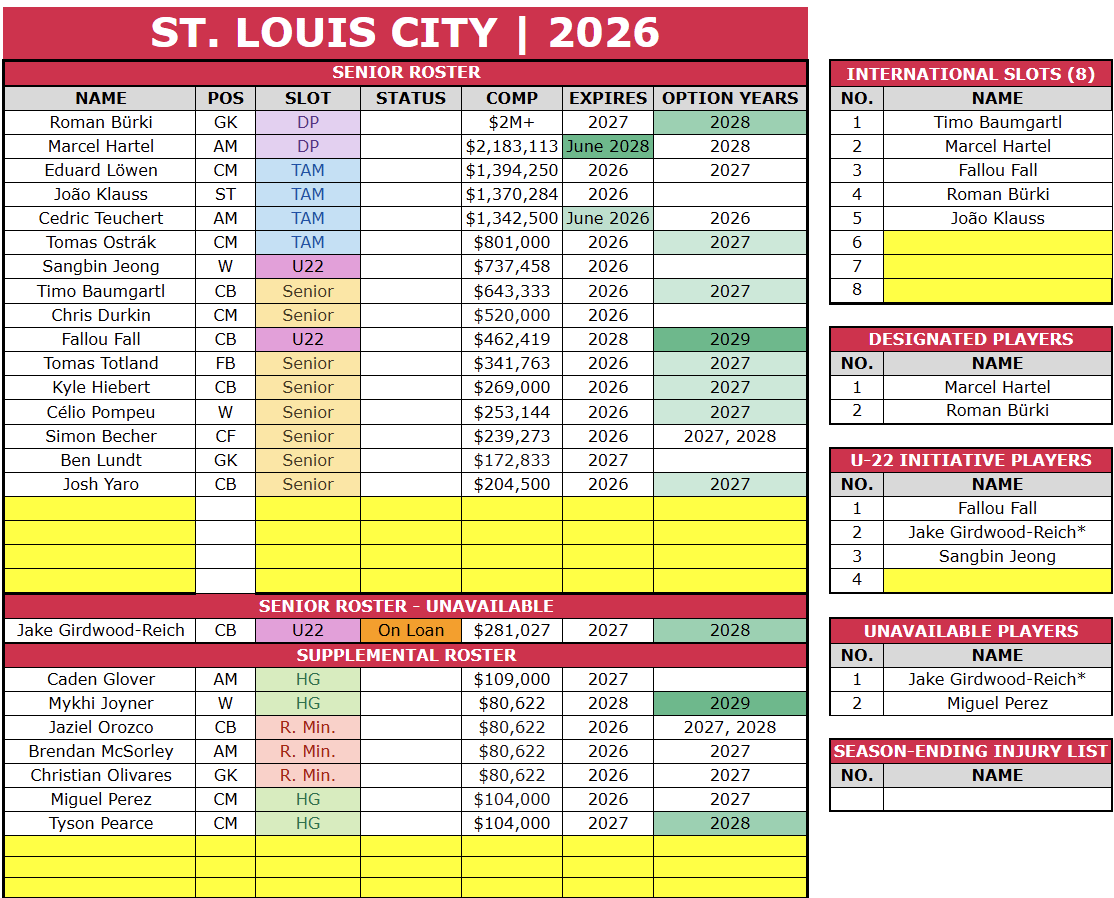
On paper, that leaves CITY with seven open roster slots as of the Yaro signing—but not really. The functional breakdown shakes out as four senior slots and three supplemental slots (or four, if someone like Glover or Pearce occupies Slot 31 in 2026).
A depth chart of the current group would look something like this:
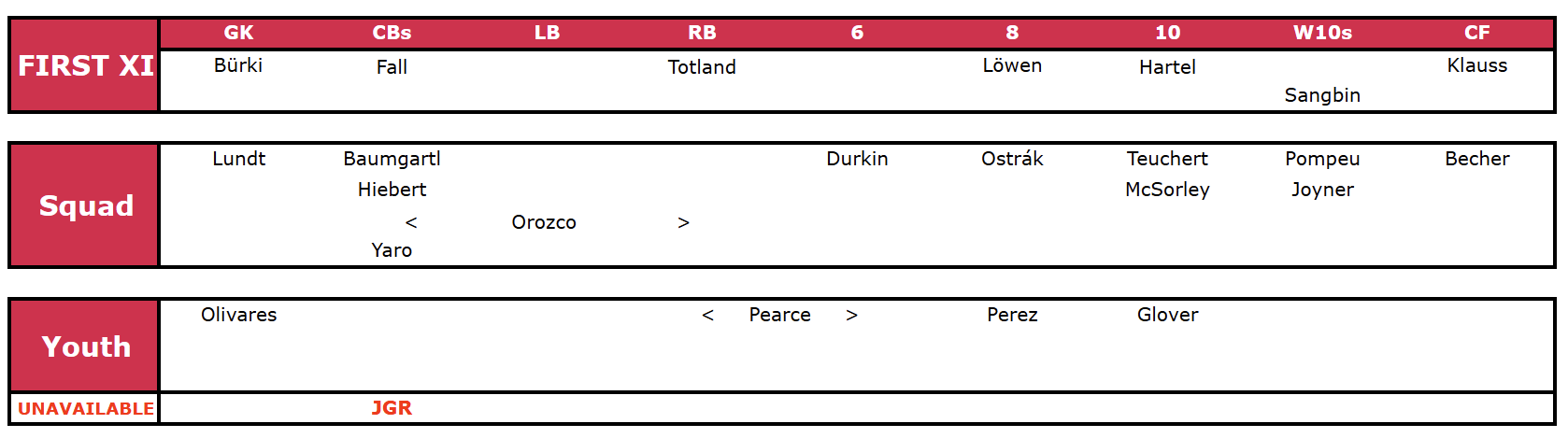
And as you can see—borrowing the name from a childhood favorite—this roster has… “Holes.”
CITY currently does not have a starting CB to pair with Fall, with Kessler out of contract. They do not have a left back in the building in any capacity after Horn left in the summer, Wallem and Padelford’s loans expired, and Reid’s contract situation remains unresolved. Do they have a right back? Hard to say. Critchley practically acted as if Totland didn’t exist, to the point it wouldn’t be shocking if Totland pushed for a move. And Zalinsky isn’t under contract either.
CITY also does not have a 6, and they badly need upgraded attacking firepower—whether on the left or the right.
To highlight just how much work is in front of them, I highlighted the holes here:
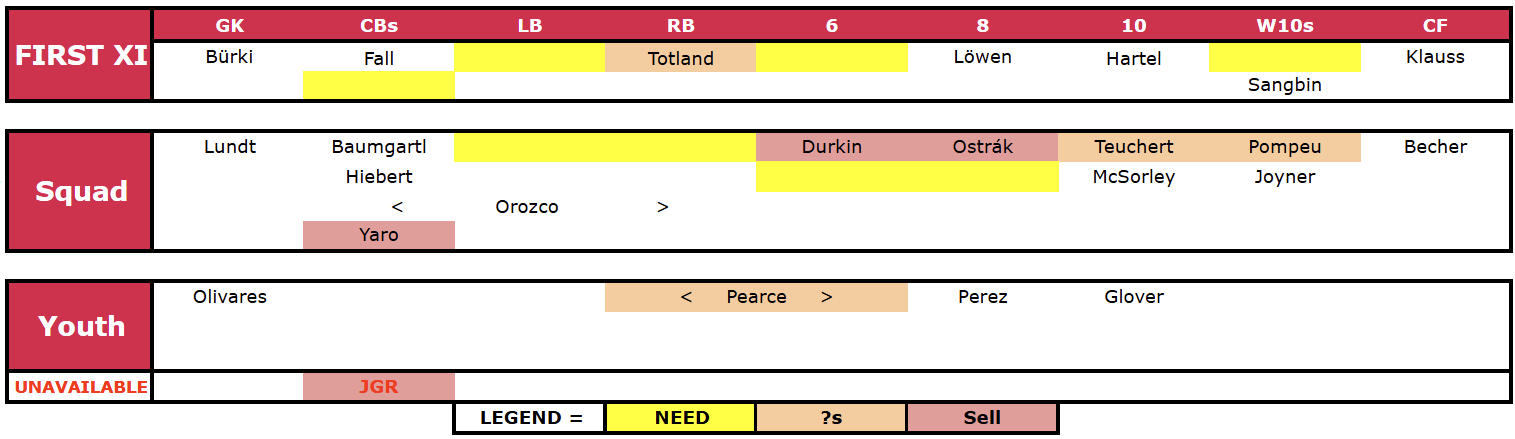
And circling back to that nauseating Senior/Supplemental distinction: that’s a lot of holes to fill with only four senior slots. At minimum, CITY needs four starters at RCB, LB, the 6, and W10.
But here’s the real kicker: Supplemental slots are more complicated to fill than Senior slots.
Why? Because good supplemental players are like cheat codes in MLS. Teams that land productive supplemental contributors have struck gold—they’re cheap, they allow roster flexibility, and 20 senior slots alone don’t give you a starting XI and real depth.
As a result, it’s almost impossible to pry another team’s productive supplemental players away. The teams that have them know exactly how valuable they are. That reality forces you to chase players like Padelford—talented, under-utilized pieces from other clubs who might break through with a change of scenery. But even then, CITY only got him on loan, which isn’t ideal for long-term squad building.
And that’s essentially where this roster sits right now, strictly from a numbers and positions standpoint.
But an accurate roster audit goes deeper than filling holes. It requires evaluating the squad’s age profile, career arcs, and where players are heading—not just where they are. Managing who is entering, exiting, or in their primes is a core part of planning the next two to three roster cycles.
Roster Age
A couple of years ago, The Athletic and its team of nerds conducted an exercise to map out the “peak” or “prime” ages by position. Is that an exact science? Absolutely not. For every Wayne Rooney exploding onto the scene at 16, there’s a Niclas Füllkrug who doesn’t fully bloom until 28. The point isn’t precision—it’s getting a general sense of when players, on average, enter their prime.
We all understand this intuitively. Fallou Fall is not in his prime; he has years of development ahead of him. Roman Bürki, meanwhile, is firmly on the downturn. And that’s not an insult—Father Time is just like gravity: undefeated. Fight all you want, but eventually, both pull you right back down to earth.
Using the groundwork from The Athletic, I applied those positional windows to the 24 players under contract for 2026, as of their age at the start of the 2026 season, to gain a clearer picture of where this roster stands today and where it’s headed. The results look like this:

A few things jump off the page right away:
— Center forwards? Perfect. That age profile is right where you want it.
— Centerbacks? They’re either old… or 21.
— And Bürki? Yeah, he’s old.
When I finally got all the kinks out of the coding and it spit out this graphic, I asked myself a couple of questions:
1. What does this say about our best players?
Bürki is well past his prime.
Löwen and Hartel have aged out of it.
Klauss is in the thick of it.
That’s a squad-planning problem. Perhaps not a 2026 problem, but definitely a 2027–2028 and beyond issue. Your best players shouldn’t all be aging out at the same time unless you’re planning a rebuild. CITY has consistently pushed back on this idea of rebuilding.
2. What about the not-yet-in-their-prime group? Any stars coming?
Yes—Joyner and Fall. Both years away from their peaks.
Suitable for long-term planning.
Not great for 2026 if you expect them to be difference makers.
They aren’t ready. They shouldn’t have to be.
3. And the biggest question: Are the prime-age players the “core” of the team?
They’re supposed to be.
This is the group that should define your identity, drive your results, and carry the squad through the grind of the season.
Instead?
Your prime-aged group is:
— a backup GK
— a backup CB
— a right back the interim coach iced out
— one CM who’s never lived up to the price tag
— another CM who doesn’t have a place in a modern midfield
— and a LW who dribbles a lot, scores a crazy goal here and there, and that’s about it
These are supposed to be the cornerstones—giant neon arrows pointing where the club is going. Instead, outside of the Klauss/Becher CF bromance, you can argue that not a single prime-aged player on the entire roster should be starting in 2026.
That’s… not good, folks.
CITY needs a massive infusion of prime-aged players to raise both the floor and the ceiling of this squad. And with only four senior slots open, they need to go 4-for-4.
No misses. No flyers. No “maybe he’ll pan out.”
They need four starters in their prime.
Or 2026 is going to look a lot like 2024 and 2025—but with even less margin for error.
The Squadit
(Squad Audit… get it?)
We’ve looked at the roster construction. We’ve looked at the age profile. Now it’s time to dig into the part that actually decides matches: the players themselves, and What Would Michael Do?
Goalkeepers — 3/3
Ages: 35, 30, 24
Roster Slots: DP, Senior, Supplemental
CITY has the full goalkeeper archetype chart covered: an overpaid, aging Designated Player starter, an average MLS backup, and a young project.
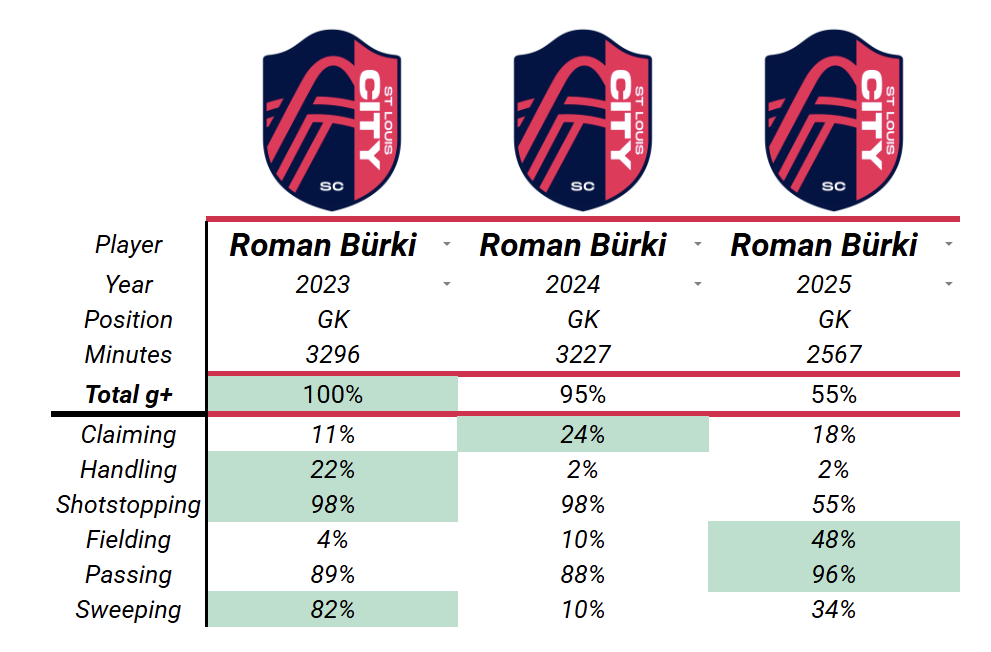
It’s functional, but far from efficient. Most front offices won’t risk giving the No. 2 job to a cheaper, younger option—because if it blows up, someone’s unemployed—but burning a senior roster slot on a backup goalkeeper is still bad roster economics. Those spots need to move the needle, not sit behind Bürki for 90% of the season.
WWMD: I’m not touching GK1 or Olivares, but I’m absolutely freeing that senior slot. A supplemental backup goalkeeper is perfectly fine, and in case of emergency, just lean on short-term call-ups from CITY2 to back up the backup. Use the reclaimed senior spot on an outfield player who can actually influence results. CITY won’t do that—and I think it hurts their ability to turn this ship around.
Centerbacks — 4/5 + 1
Ages: 31, 30, 28, 21, + 21 (Loaned)
Roster Slots: Senior, Senior, Senior, U22, + U22 (Loaned)
This is exactly what you don’t want from squad planning: three backup CBs soaking up Senior slots, one U22 spot wasted on a player currently operating on Australia time, and one genuinely promising U22 LCB in Fallou Fall. This is a picture of a position group filled with warm bodies, just to show they’re occupied.
Breaking news, St. Louis CITY SC: warm bodies do not win games. But they sure lose them.
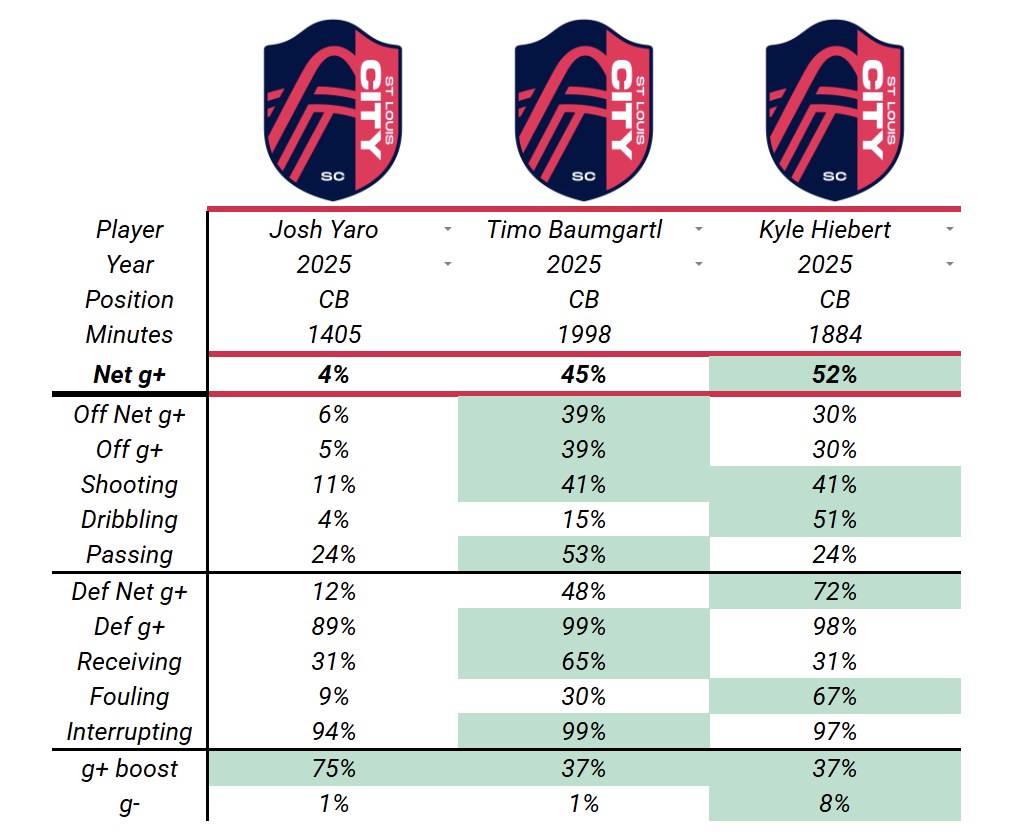
Two of these guys are serviceable MLS backups—you can squint and see 1,000–1,500 minutes in that role and be fine. The third, the one CITY extended on Thursday, November 13th (a move that multiple people with knowledge have suggested was finalized before Wray’s appointment), is a tiny glimpse into exactly why this team has missed the playoffs in consecutive seasons.
CITY is drowning in inadequate supplemental-level talent, both on the actual supplemental roster and—more critically—on the fringes of the XI where depth should live. Rewarding one of the worst CBs in MLS in 2025, who didn’t play a single minute in the final three months of the season, is just stupid.
Re-signing Josh Yaro does not guarantee 2026 will fail. It also won’t guarantee it succeeds. What it does provide is yet another window into how fundamentally broken this club’s internal processes are. Corey Wray appears to be very good at his job, and CITY fans should be thrilled he’s here. But as long as two-thirds of the braintrust that built one of MLS’s worst teams continues to call shots, it’s hard to imagine Wray turning water into wine.
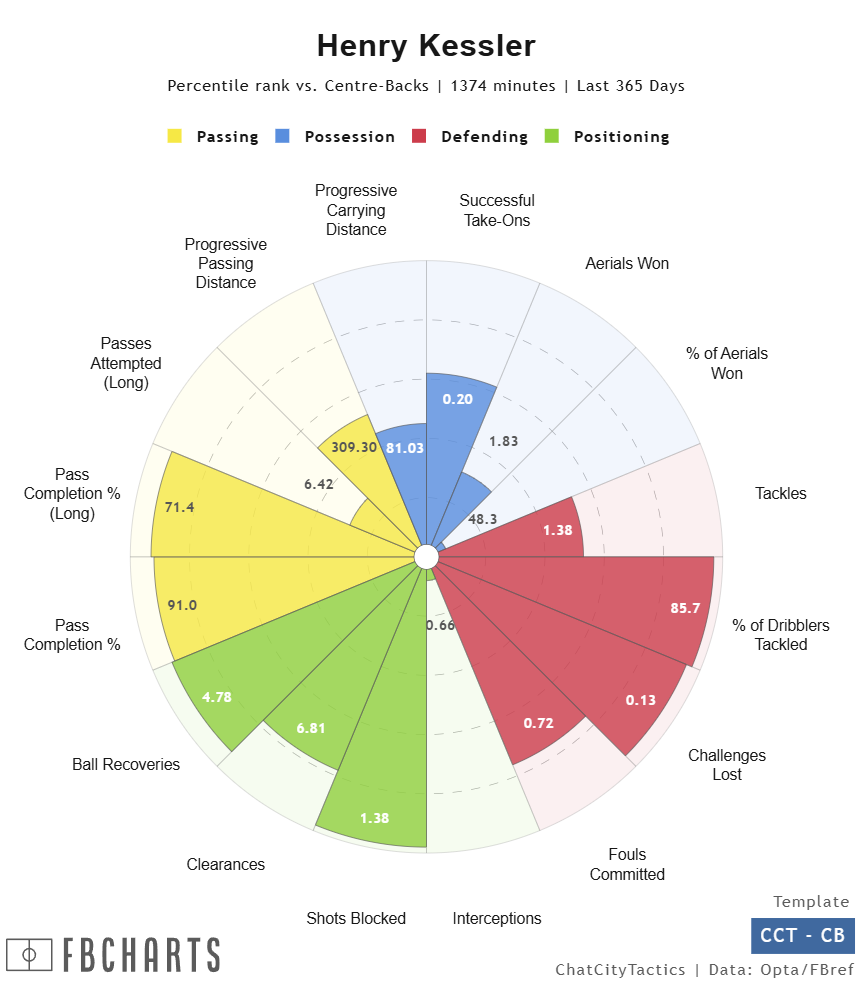
WWMD: Sign a real starting RCB—Senior/TAM money—especially someone who’s comfortable on the ball. Henry Kessler would be a great option. Maybe we should do that. And whatever you need to do with the JGR signing? Do it. A Carnell-inspired signing for a system allergic to the ball, he needs a clean runway to a permanent home elsewhere. Ideally, his stint in Australia goes well, he sticks, and CITY gets the roster space back.
Fullbacks— 1/4
Age: 27
Roster Slot: Senior
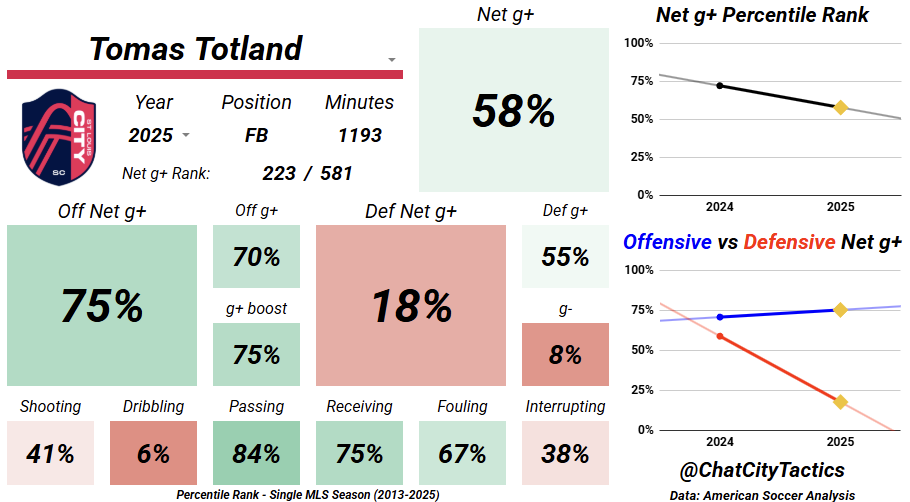
Yep. CITY currently has one rostered fullback—and nobody would be shocked if he left this winter after being placed in tactical solitary confinement for the entire second half of the season. Jannes Horn was CITY’s longest-tenured left back, and he wasn’t even here for 12 months (and half of that was spent playing left-sided centerback).
If we assume Totland sticks around, CITY still needs, at minimum:
a starting left back,
a backup left back, and
a backup right back.
Three missing players. One position group. One guy under contract.
This is roster malpractice.
WWMD: Padelford and Zalinsky are my choices for backup, supplemental fullbacks. Reid clearly wasn’t the same after his injury, and he needs real minutes to find out if he can still be the player he was trending toward becoming. That won’t happen as a backup, and CITY needs the stability Padelford showed during his loan.
For the starter, I’m looking for a LB—domestic or international, doesn’t matter—who is stable, reliable, and not a liability in either phase. Doesn’t need to be flashy. Doesn’t need to overlap like Alphonso Davies. Just someone who consistently does their job and doesn’t start fires they can't put out themselves.
A few names come to mind…
But we’ll save that teaser for the next episode.
Utility - 1/1
Age: 21
Roster Slot: Supplemental
This is a new category I’m introducing: the Utility spot. Due to MLS roster limitations, every team needs at least one player who can fill holes across multiple positions. In CITY’s case, that’s Jaziel Orozco.
Is he great? No.
Is he good? Probably not.
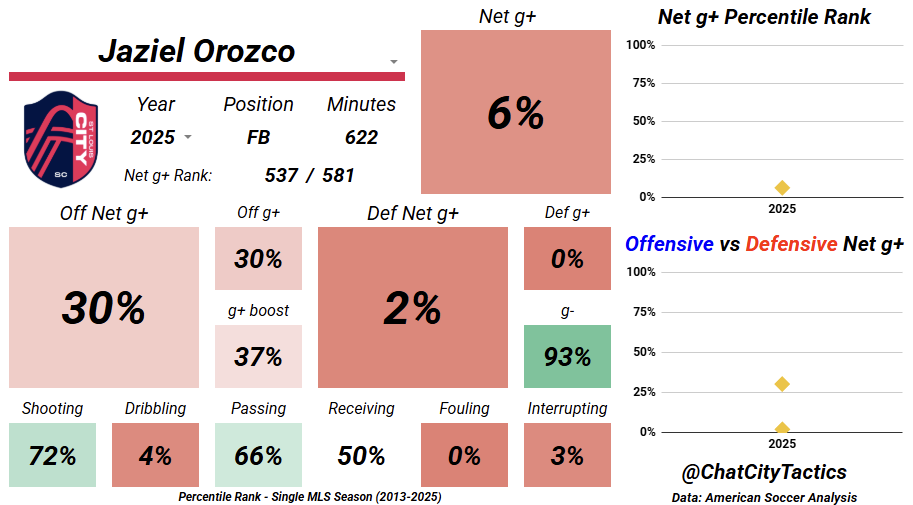
But he is young, and he is cheap. Both are things you cannot say about the other defender with a sub 10% Net g+ percentile.
He offers almost nothing on the ball, and he’s already conceded the second-most penalties in CITY history… in 531 minutes. But here’s the thing—he doesn’t need to be great or good. He needs to be available, positionally flexible, and not actively harming the team when he plays. That last part is still a work in progress.
WWMD: Orozco should be the third-choice left back, the third-choice right back, and the 5th/6th centerback, spending most of his time playing with CITY2 to stay match sharp. This is the warm-body slot, the break-glass-in-case-of-emergency role. Players don’t dream of being this guy, but every successful MLS team has one.
Hopefully, Orozco can grow into that role for CITY in 2026.
Math
Goalkeepers: 3/3
Centerbacks: 4/5 +1
Fullbacks: 1/4
Utility: 1/1
1 DP, 5 Senior, 2 Supplemental, 1 U22 + 1 U22 (loaned)
That’s 9 players filled out of 13 possible spots, across the back line and utility roles—leaving 4 clear holes and using a U22 spot on a loaned player.
Moving on.
Central Midfield (6s & 8s) - 4/5
Age: 29, 26, 26, 20
Roster Slot: Senior, Senior, Senior, Supplemental
Where do we begin?
Eduard Löwen is one of the best deep-lying playmakers in MLS. He fully justifies the Senior slot and the TAM it took to bring him here. But he’s also 29, likely past his positional peak, and that’s before considering the very real off-field challenges weighing on him and his family. He’s CITY’s starting 8—no question.
But who’s backing him up?
Ostrák has shown flashes of central ball progression, but defensively, he’s a mess. For one of the most expensive players on the roster to still not have a position or a clear starting role in four years is more than a concern—it’s a verdict. He’s probably just not good enough, and CITY needs better value for that salary and slot.
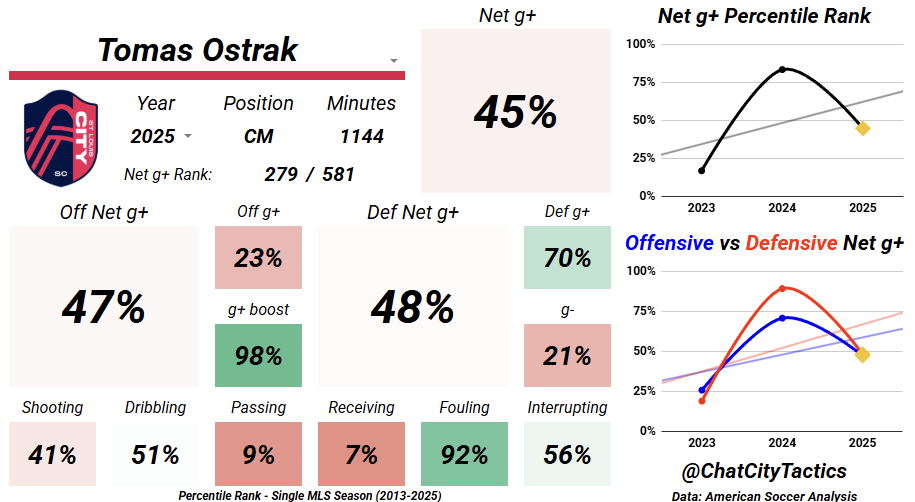
Miguel Perez had a far better showing in MLSNP with CITY2 than he did in the USL with Birmingham. Should that be concerning? Probably. He’s young, and there’s plenty of runway for a 20-year-old midfielder. Still, the gulf between MLSNP and MLS is enormous—especially when CITY exploits the league by pitting grown men against teams fielding actual teenagers. Projecting Perez with confidence is nearly impossible. He’s almost certainly not a 6, but he’s perfectly fine as the third 8 on the depth chart.
And then there’s Chris Durkin. The 26-year-old former U22 player, now a senior, who can’t really play the 6. CITY needs help here—desperately.
WWMD: Sell Ostrák. Bring in a more well-rounded, even if less flashy, 8 who can actually contribute when Löwen is out. Sell Durkin. Spend real DP money on a game-changing 6—a midfielder who can control possession from deep, protect the backline, and allow Löwen and Hartel to operate higher up the pitch where they’re most dangerous.
And because Durkin is gone in this scenario, replace him with a proper backup 6. Whether that’s a veteran like Morales or a young flier from the supplemental/USL pool, the key is simple: you cannot play modern soccer with a midfielder who can’t retain and control the ball. Full stop.
Both of those guys are in their prime. Need to replace them as such or with younger ones.
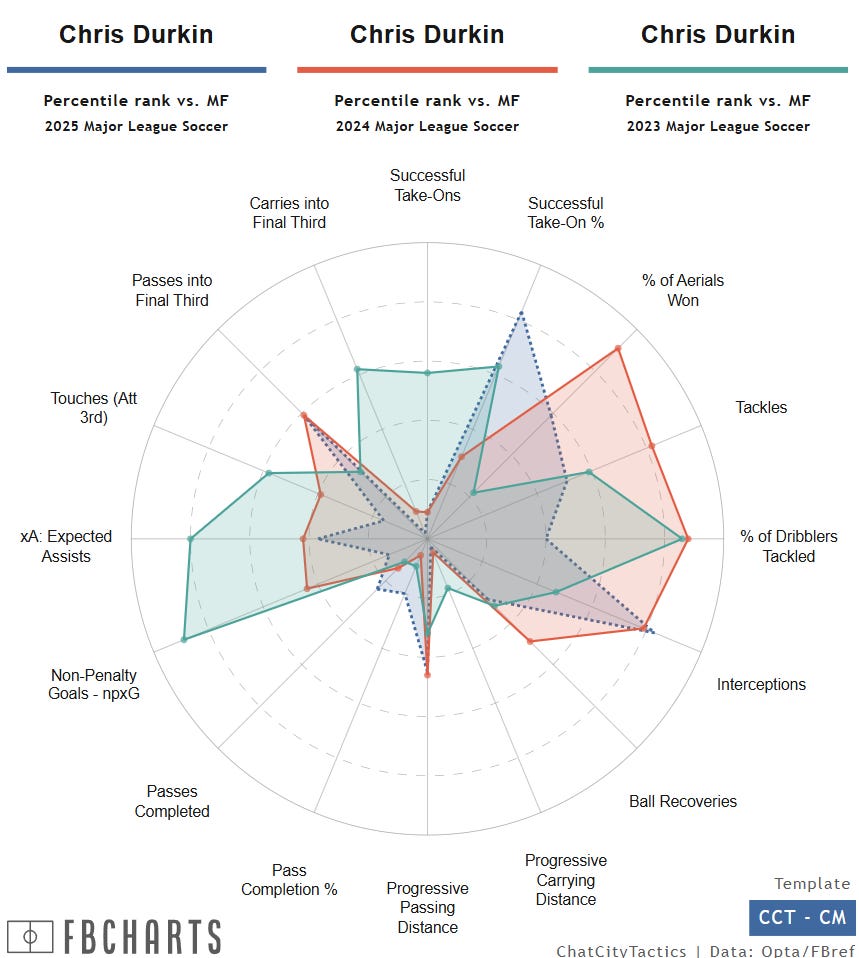
The absence of any colors pointing south is not something CITY can stomach in 2026.
Exercising Durkin’s option makes sense only as a transactional move—to extract any return possible. But there is no long-term place for his skill set in this squad. CITY must move forward with midfielders who can actually… move the ball forward.
Wingers— 3/4
Ages: 26, 23, 19
Roster Slots: Senior, U22, Supplemental
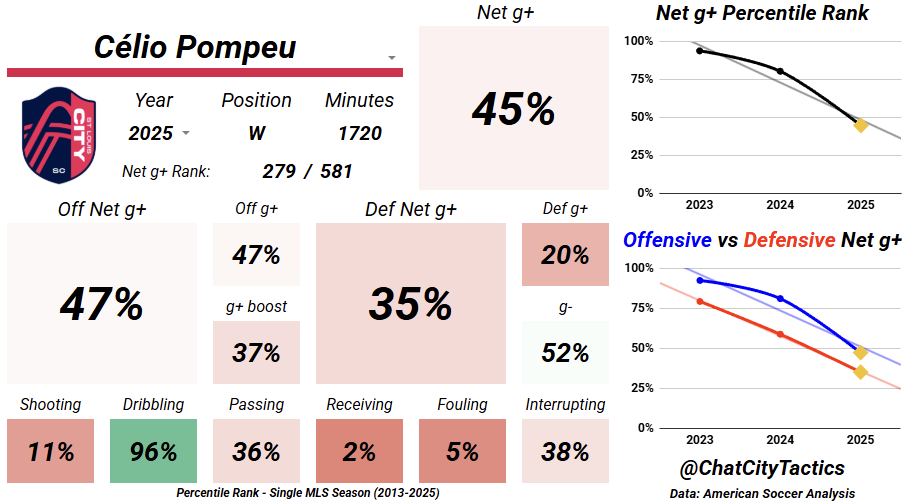
Pompeu might be the single hardest CITY player to evaluate in the club’s existence. On paper—and in the stands—he does exactly what people pay to see. He’s a get-butts-out-of-seats winger. Flicks, tricks, beating defenders 1v1. And he’s extremely good at that part.
The issues are… everything else.
Outside of the occasional Goal-of-the-Year contender, he doesn’t really score. And he doesn’t really assist. In 3,700 MLS minutes, he has 6 goals and 6 assists—overperforming xG, underperforming xAG, but landing perfectly on their combined total of 12.0. For a winger who regularly roasts his defender in isolation, it’s a pretty underwhelming return for someone in his prime. Add in his frequent defensive lapses, and the picture gets murkier.
He’s good enough to be a squad player.
He’s also good enough—and valuable enough—to sell.
Sang-bin, now extended through the final year of his U22 deal, is the most likely starter on the right unless CITY brings in a true marquee addition. At 23, that’s a great place to be for long-term planning. His physical traits are elite; his technical ceiling is still a work in progress. As he approaches his prime, CITY needs that curve to keep rising.
Joyner, the wunderkind, complicates the calculus. Bringing in a star left winger naturally cuts into the kind of minutes everyone—fans, the club, and the league—would prefer Joyner to see. However, relying on a Pompeu/Joyner platoon on the left keeps CITY short on proven firepower, continuing the trend of a team punching below its weight in terms of attacking output.
He’s years away from his best. He just needs meaningful minutes. Any additional playtime for him with CITY2 would be a waste of time.
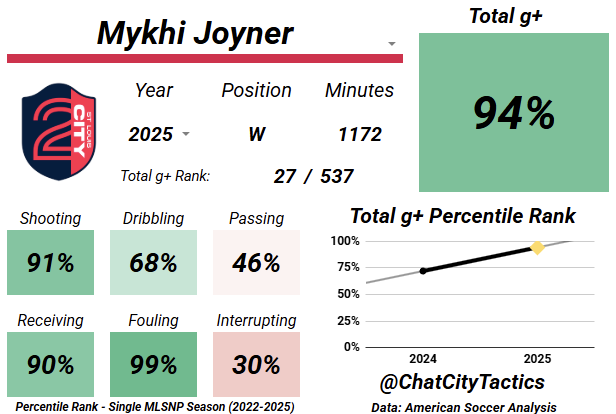
WWMD: CITY needs an upgrade here—full stop. The cleanest solution is to sign a right-footed LW who actually produces goals and assists. That immediately raises the floor of the attack, and because Joyner exists, that player doesn’t have to be in their prime. You can sign someone slightly older, knowing that as they decline, Joyner should be pushing for more and more minutes.
Yes, that puts some weight on the shoulders of a teenager—and the most dangerous word in sports, potential—but CITY should be capable of reinforcing the position while still giving Joyner room to breathe and grow.
At the very least, however, CITY needs a fourth winger, ideally a left-footed player, to provide different angles, shapes, and profiles in the attack.
Math 2.0
Goalkeepers: 3/3
Centerbacks: 4/5 (+1 loaned)
Fullbacks: 1/4
Utility: 1/1
Central Midfield: 4/5
Wingers: 3/4
Roster Slot Breakdown:
1 DP
9 Senior
4 Supplemental
2 U22 + 1 U22 (loaned)
That puts CITY at 17 players and 6 holes—and that’s before factoring in my recommendations to sell two central midfielders.
Moving on.
Attacking Midfielders
Ages: 30, 29, 24, 18
Roster Slots: DP, Senior, Supplemental, Supplemental
This group is split cleanly into two: the post-prime stars and the kids.
The two older players are, simultaneously, the best player in the squad and the most frustrating player in the team.
Let’s start with the easy one: Marcel Hartel. There’s no need to wax poetic—he’s just really, really good. He quietly had the second-best G+A season of his career last year, and yet not enough people are talking about it. He’s the engine of this team.
Cedric Teuchert, however, is a far more complicated conversation. Ironically, for a guy who couldn’t buy a goal last season, he’s still the best pure finisher on the roster. The problem—one everyone saw—is everything that happens when he isn’t scoring.
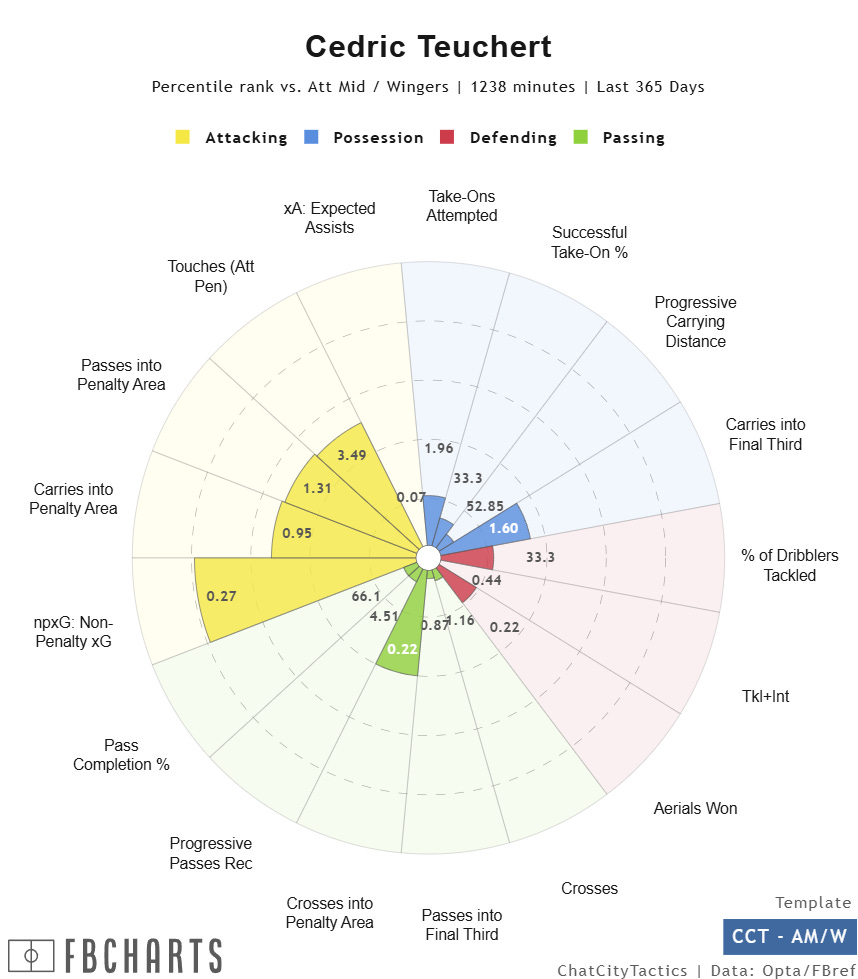
He doesn’t contribute to buildup.
He won’t beat a man off the dribble.
He doesn’t have the pace to stretch defenses.
And most importantly: where does he play?
Hartel can play inverted from the left, but we’ve all seen how much more freedom—and impact—he has centrally, drifting into whichever pocket the game demands. Slotting Teuchert into a front four with Klauss and Hartel turns CITY into the Need for Speed’s DMV: painfully slow. Even if you added Usain Bolt, the collective profile is still too slow to threaten MLS defenses.
And then there’s Teuchert’s contract. It expires in the summer. He’s expensive. He’s aging. And he’s boxed in by worst-case economics:
Great season? Too expensive to extend.
Bad season? Walks for free.
Average season? No transfer value, extension through ‘26 doesn’t change anything.
This is the definition of a value trap.
The kids are a different story.
McSCOREly arrives just as he’s entering his prime at 24. He should be given every opportunity to take over Teuchert’s role once Cedric leaves, but for now he’s depth and an impact sub.
As for Glover, Slot 31 has his name written all over it.
WWMD: Do nothing—for now. Teuchert leaves one way or another after 2026, and then the real work begins: finding a younger 10 who can understudy Hartel and eventually take the mantle. That succession plan should be a priority the moment Teuchert’s contract clears.
Center Forwards— 2/2
Ages: 28, 26
Roster Slots: Senior, Senior
Finally—some clarity.
CITY’s striker group is the one position in the entire squad that is both set and competent, and shockingly, both players are in or just entering their primes.
Let’s start with Klauss.
He is who he is at this point: a high-effort, high-chaos, back-to-goal forward who can create his own shot, bully centerbacks, and drag defenses into uncomfortable zones. When he’s healthy and engaged, he’s one of the better all-around No. 9s in MLS. When he’s not? Well… we’ve seen the streaks. But the talent is undeniable, and he is a locked-in starter for 2026 unless someone drops a bag on the CITY doorstep.
Then there’s Sam Adeniran’s spiritual successor—just kidding.
It’s Becher.
Becher is a good modern MLS backup No. 9:
intelligent movement
works hard defensively
consistently finds dangerous pockets
And, he’s CHEAP
Could CITY upgrade from either? Sure. But is that where the focus should be? Absolutely not.
This is one of the few areas where CITY actually executed squad planning correctly: two strikers in their mid-late 20s, different enough to complement each other, and both capable in their own right (if Becher can start scoring again).
WWMD: Nothing. This is the one position that is stable, efficient, and aligned with proper roster construction. Reinforce the wings and midfield, and let Klauss and Becher do what they do. If anything, keep an eye out for a young, cheap third forward for CITY2, who offers more speed and who can be an emergency call-up—but this position does not need Senior-slot resources.
The End
Goalkeepers: 3/3
Centerbacks: 4/5 (+1 loaned)
Fullbacks: 1/4
Utility: 1/1
Central Midfield: 4/5
Wingers: 3/4
Attacking Midfield: 4/4
Center Forwards: 2/2
Roster Slot Breakdown:
2 DP
12 Senior
6 Supplemental + Pearce
2 U22 + 1 U22 (loaned)
In compiling this list, I purposefully excluded Tyson Pearce. Not because I don’t think he has a future, but because I genuinely don’t know where to put him. Some conversations suggest that he is viewed as a right-back; others indicate that he could play centrally. Either way, he’s 18, on a supplemental slot, and a strong candidate for Slot 31. His time will come—just not in this audit.
So that’s the 24-man squad as it currently stands. A mix of old and young, with very little contribution from the prime-aged core. There’s a ton of work to do. Let’s bring that colored depth chart back into view.

By my count, this roster has:
8 actual “needs”
4 question marks, each for different reasons
3 players who should be gone before the season kicks off in February
That’s a lot of work to accomplish with only 6 available roster slots.
Mathematically, it borders on improbable.
Anyway—I hope you enjoyed this Roster Audit, or at least found it informative. In Part 3 of the WWMD Offseason Series, we’ll shift from identifying the problems to solving them:
New faces, new signings, and rebuilding a roster that needs it.
#AllForCITY, forever and always.